Game guide · XINVENTURES
The Gin Rummy playbook
Begin with the objective. Build sets and same-suit runs in a ten-card hand, then knock with 10 or fewer deadwood points or go Gin with none. Check the relevant controls before continuing. Take a moment to read the table. The game uses a single 52-card deck with no jokers. Both players receive 10 cards. Aces are low and count 1. Take the next action only when the current step is clear.
Two-player game against a computer. Fixed house scoring: 25-point Gin and undercut bonuses; first to 100, no line/game bonus. The starting player alternates each hand. Big Gin is not included. Current hands save locally.
An idea for your next attempt
Keep the active rule in mind. The starting player may take the upcard or pass. If both players pass, the starter must draw from the stock. Use another round to revisit a decision.
The goal to keep in mind
Build sets and same-suit runs in a ten-card hand, then knock with 10 or fewer deadwood points or go Gin with none. Return to the explanation when a decision is unclear. For a calm first round, focus on one decision.
From the start of a round
- The game uses a single 52-card deck with no jokers. Both players receive 10 cards. Aces are low and count 1.
- The starting player may take the upcard or pass. If both players pass, the starter must draw from the stock.
- Draw one card, then select a different discard when you took from the discard pile. Melds stay in your hand during play.
- Choose Knock / Gin with a selected discard. After discarding, deadwood must be 10 or less. Otherwise continue playing.
- Against a knock, the defender may group cards and lay off unmatched cards on the knocker’s melds. No layoffs are allowed against Gin.
- Gin earns 25 plus defender deadwood. A successful knock earns the difference. A defender with an equal or lower count undercuts for 25 plus the difference.
- The first player to reach 100 points wins this match. There are no additional line or end-of-match bonuses. A stock reduced to two cards ends a non-knocking hand with no score.
Getting comfortable with the controls
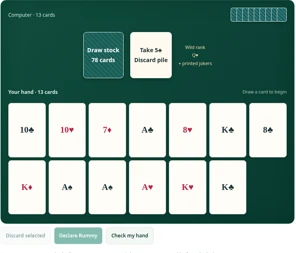
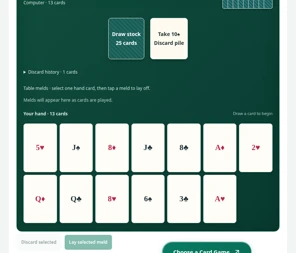
Tap a card to select it. Use the labelled pile and action buttons. Sort by rank or suit; the hand wraps onto additional rows on a phone. Use another round to revisit a decision. Keep the active rule in mind.
A closer look at one example
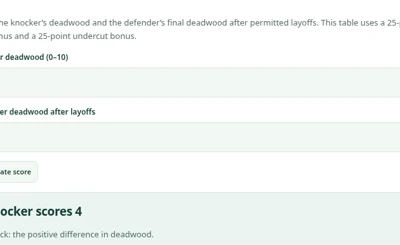
A knocker with 8 deadwood against a defender with 5 after layoffs is undercut: the defender scores 25 + 8 − 5 = 28. Take the next action only when the current step is clear.
Where a round can go wrong
Keep the active rule in mind. Q–K–A is not a Gin run: Aces are low. A defender cannot lay off against Gin, and a picked-up discard cannot be returned on the same turn. Use another round to revisit a decision.
Questions that come up during play
What is the aim?
Build sets and same-suit runs in a ten-card hand, then knock with 10 or fewer deadwood points or go Gin with none. Look at the complete hand before deciding. Take the next action only when the current step is clear.
How do I use the controls?
Tap a card to select it. Use the labelled pile and action buttons. Sort by rank or suit; the hand wraps onto additional rows on a phone. Work at your own pace. Check the relevant controls before continuing.
Which format is available?
Two-player game against a computer. Fixed house scoring: 25-point Gin and undercut bonuses; first to 100, no line/game bonus. The starting player alternates each hand. Big Gin is not included. Current hands save locally. Use the rule sheet as a reference. The same rule applies on a phone and on a computer.
What should I check before a move?
Q–K–A is not a Gin run: Aces are low. A defender cannot lay off against Gin, and a picked-up discard cannot be returned on the same turn. A clear plan starts with the current position. Return to the explanation when a decision is unclear.
Can you give an example?
A knocker with 8 deadwood against a defender with 5 after layoffs is undercut: the defender scores 25 + 8 − 5 = 28. Look at the complete hand before deciding. Take the next action only when the current step is clear.
When may I knock?
After drawing, select the card you would discard. The remaining 10 cards must have no more than 10 deadwood points. A clear plan starts with the current position. The same rule applies on a phone and on a computer.
How much is an Ace?
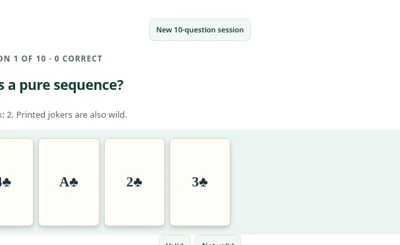
An Ace is worth 1 and only starts a run: A–2–3 is valid, Q–K–A is not. Work at your own pace. Return to the explanation when a decision is unclear.
What happens on a deadwood tie?
Unless the knocker went Gin, a tie is an undercut; the defender scores the 25-point bonus. Take a moment to read the table. Use another round to revisit a decision.
Are layoffs automatic?
Yes. The result searches the defender’s legal groups and possible extensions to find the least remaining deadwood. Take a moment to read the table. The same rule applies on a phone and on a computer.
Can a hand end without a winner?
Yes. When the stock is reduced to two and the active player ends the turn without knocking, the hand has no score. Before making a move, check the cards in view. Take the next action only when the current step is clear.